

Website pricing is one of the most frustrating parts of planning a new site. One business gets quoted $2,000. Another gets quoted $20,000. A third is told the project could land somewhere north of that. To most business owners, all three are supposedly for “a website,” which makes the process feel vague before it’s even started.
“Website” can mean four completely different things.
A brochure site, a custom marketing site, an ecommerce build, and a custom platform might all be called a website, but they involve very different levels of planning, functionality, and long-term support.
That confusion usually comes from treating very different types of websites as the same thing. A small template-based brochure site is not the same as a custom marketing website. A custom marketing website is not the same as an ecommerce build. And an ecommerce build is not the same as a platform that needs integrations, scalable content, user flows, and long-term flexibility.
That’s also why price alone isn’t a useful way to judge value. A cheaper build may look acceptable at launch but become expensive later if it’s hard to update, hard to grow, or poorly structured for search. Google’s own documentation emphasizes the importance of crawlable structure, clear content, and site organization, which means the underlying build quality matters more than many businesses realize.
In Canada, this matters even more because online expectations are no longer limited to large retailers. Statistics Canada continues to track strong e-commerce activity across industries, and once customers get used to clean navigation, fast access to information, and easy online transactions, they expect it everywhere.
The better question isn’t “how much does a website cost?” It’s “what kind of website does your business actually need?”
Why website quotes vary so much
Two businesses can ask for “a new website” and get wildly different quotes because they are not asking for the same thing, even if they think they are. One may need a simple brochure site with a few fixed pages. Another may need a custom marketing site with landing pages, SEO structure, and room for ongoing content. A third may need ecommerce, integrations, custom functionality, or a backend that supports internal workflows.
This is where pricing conversations go sideways. The lower quote is not always wrong, and the higher quote is not always inflated. They may simply reflect very different assumptions about design quality, technical scope, flexibility, performance, and how much the site needs to do after launch.
That is also why a proper website quote should not just list a price. It should clarify what is being built, how custom it is, what systems it connects to, and how easy it will be to maintain as the business changes.
Typical website cost ranges in Canada
Most professionally built websites in Canada fall into a few broad ranges:
- $1,000 – $5,000: Template-based or entry-level builds
- $5,000 – $15,000: Custom small business websites
- $15,000 – $40,000+: Advanced builds, ecommerce, or custom platforms
These ranges are not strict rules, and there is overlap between them. A very small custom site may land at the lower end of the middle range, while a content-heavy or integration-heavy website build may move up quickly. What matters most is not just the number of pages, but how much structure, functionality, and planning the site needs to work properly.
In other words, two sites with the same page count can have very different costs. One may be little more than a polished brochure. The other may be a core business tool that supports lead generation, content growth, search visibility, campaign traffic, and internal updates for years to come.
What actually drives the cost
Pricing comes down to complexity, not just design. The biggest factors are:
- Custom design vs pre-built templates
- Content structure and scalability
- Integrations like CRMs or ecommerce platforms
- SEO setup and performance optimization
- How easy the site is to update later
A site that’s easy to launch isn’t always easy to manage. That’s where the real cost difference shows up.
What businesses are really paying for
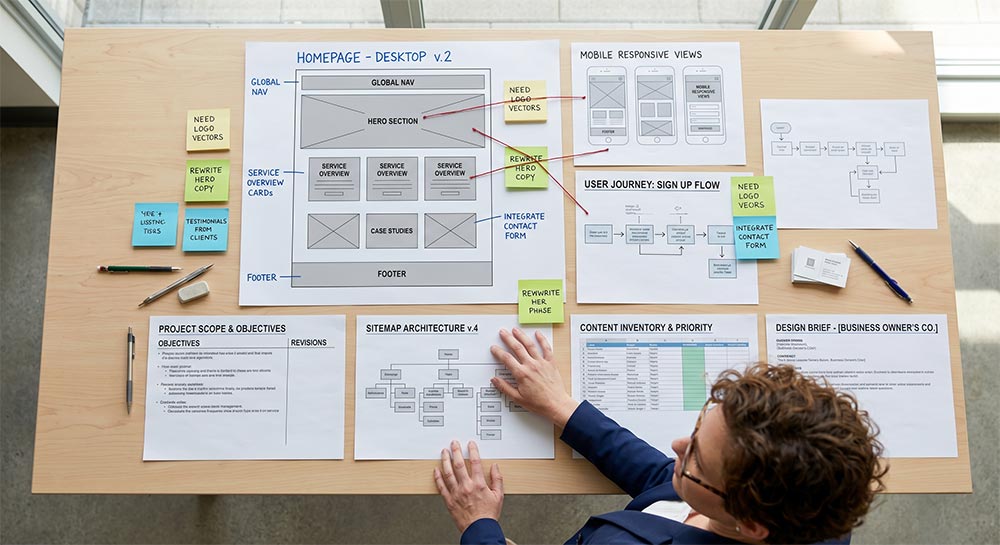
When businesses invest in a professionally built website, they are not just paying for visuals. They are paying for planning, structure, usability, technical reliability, and a build that will not fight them every time something needs to change.
Good website work reduces friction across the entire site. It makes content easier to add, campaigns easier to support, and future changes easier to manage. That doesn’t usually show up in screenshots, but it has a huge effect on whether the site remains useful six months or two years after launch.
Why cheaper websites often cost more later
Lower-cost websites usually focus on getting something live quickly. That can work in the short term, but the weaknesses tend to show up once the business starts trying to use the site more seriously.
- Content becomes hard to update
- New pages don’t fit the existing structure
- SEO performance stalls because the site wasn’t planned properly
- Campaign traffic lands on pages that don’t convert well
- Design consistency starts to break down as new needs are added
This is especially costly for ecommerce businesses. Baymard’s ongoing checkout research continues to show that friction in the buying experience has a measurable impact on abandonment, which is a reminder that weak structure and UX choices don’t just make a site annoying, they can directly affect revenue.
At that point, many businesses stop improving and end up rebuilding. What looked like a savings at the beginning turns into a second project much sooner than expected.
When it makes sense to invest more
Not every business needs a large budget. But higher investment makes sense when your website plays a central role in how you operate:
- You’re running ads or driving traffic
- You’re selling products or services online
- You need landing pages or ongoing content
- Your messaging or offerings are evolving
In these cases, your website isn’t just a presence. It’s a working part of your business.
How to approach website pricing properly
The biggest mistake businesses make is treating their website like a one-time purchase. It’s not. It’s a system that needs to grow with you.
A well-built site makes it easier to launch campaigns, publish content, and adapt as your business changes. That’s where the real value comes from.
If you want to see how different approaches play out in real projects, you can explore our portfolio or learn more about how we approach website design.
Sources & Further Reading
Final thought
The right website isn’t the cheapest option or the most expensive one. It’s the one that supports your business without getting in the way. That’s what makes it worth the investment.